> For the complete documentation index, see [llms.txt](https://stack.sylius.com/llms.txt). Markdown versions of documentation pages are available by appending `.md` to page URLs; this page is available as [Markdown](https://stack.sylius.com/cookbook/admin_panel/security.md).
# Configuring the security access
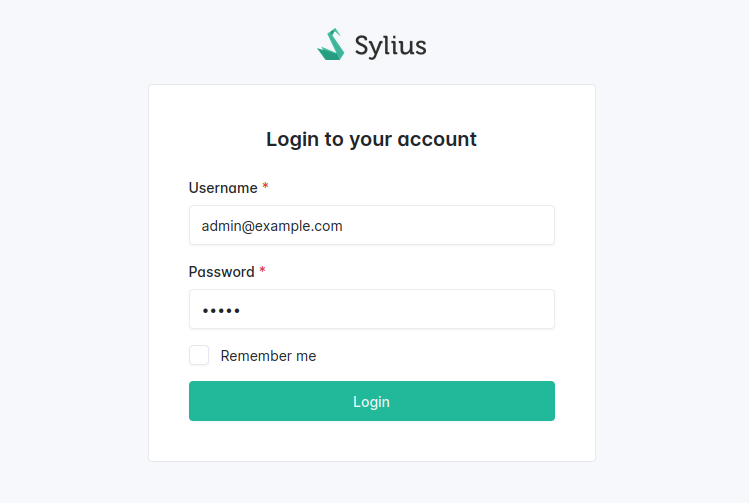
Now that you have an admin panel, you want to make sure admin users are the only ones allowed to access its URL. To secure your back-office interface, you can simply resort to Symfony's Security configuration with 4 basic steps :
* [Create a User](#create-a-user-entity)
* [Create the user provider](#configure-the-user-provider)
* [Configure firewalls](#configure-the-firewall)
* [Configure the access control authorization](#configure-access-control-authorization)
## Create a user entity
You can use the Symfony maker to create a new user.
```shell
bin/console make:user
```
{% hint style="info" %}
Learn more on how to [create a User](https://symfony.com/doc/current/security.html#the-user)
{% endhint %}
## Configure the user provider
Here is an example of a user provider configuration:
{% code title="config/packages/security.yaml" lineNumbers="true" %}
```yaml
security:
# https://symfony.com/doc/current/security.html#registering-the-user-hashing-passwords
password_hashers:
Symfony\Component\Security\Core\User\PasswordAuthenticatedUserInterface: 'auto'
# https://symfony.com/doc/current/security.html#loading-the-user-the-user-provider
providers:
# used to reload user from session & other features (e.g. switch_user)
app_admin_user_provider:
entity:
class: App\Entity\User
property: email
```
{% endcode %}
{% hint style="info" %}
Learn more on how to [create a user provider on the Symfony documentation](https://symfony.com/doc/current/security.html#the-user)
{% endhint %}
## Configure the firewall
Here is an example of how to configure a firewall for your admin routes:
{% code title="config/packages/security.yaml" %}
```yaml
security:
firewalls:
# ...
admin:
context: admin
pattern: '/admin(?:/.*)?$'
provider: app_admin_user_provider # Reuse the provider key you configured on providers section
form_login:
# These routes are provided by Sylius Admin Ui package
login_path: sylius_admin_ui_login
check_path: sylius_admin_ui_login_check
default_target_path: sylius_admin_ui_dashboard
logout:
# These routes are provided by Sylius Admin Ui package
path: sylius_admin_ui_logout
target: sylius_admin_ui_login
main:
lazy: true
```
{% endcode %}
{% hint style="warning" %}
It's important to move the main block under the admin configuration. Otherwise the admin login functionality won't work properly.
{% endhint %}
{% hint style="info" %}
Learn more on how to [configure the firewall on the Symfony documentation](https://symfony.com/doc/current/security.html#the-firewall)
{% endhint %}
## Configure Access Control Authorization
Only admin users will have access to "/admin" routes.
{% code title="config/packages/security.yaml" %}
```yaml
security:
access_control:
- { path: ^/admin/login, roles: PUBLIC_ACCESS }
- { path: ^/admin/logout, roles: PUBLIC_ACCESS }
- { path: ^/admin, roles: ROLE_ADMIN }
- { path: ^/, roles: PUBLIC_ACCESS }
```
{% endcode %}
{% hint style="info" %}
Learn more on how to [configure Access Control Authorization on the Symfony documentation](https://symfony.com/doc/current/security.html#access-control-authorization)
{% endhint %}
---
# Agent Instructions
This documentation is published with GitBook. GitBook is the documentation platform designed so that both humans and AI agents can read, navigate, and reason over technical content effectively. Learn more at gitbook.com.
## Querying This Documentation
If you need additional information that is not directly available in this page, you can query the documentation by asking a question.
Perform an HTTP GET request on the following URL with the `ask` and `goal` query parameters:
```
GET https://stack.sylius.com/cookbook/admin_panel/security.md?ask=&goal=
```
`ask` is the immediate question: it should be specific, self-contained, and written in natural language.
`goal` is what the user is ultimately trying to achieve, the reason they need the answer. Sharing it helps GitBook give you a better, more relevant answer. A goal is most helpful when it describes the outcome the user wants rather than restating the question. For example, with `ask=how do I create an API token`, a goal like `automate deployments from our CI pipeline` lets GitBook tailor the answer to that use case.
The response will contain a direct answer to the question and relevant excerpts and sources from the documentation.
Use this mechanism when the answer is not explicitly present in the current page, you need clarification or additional context, or you want to retrieve related documentation sections.